Clinical Science Review · Vol. 1 · For healthcare professionals
One Number, Measured Correctly
Abstract
- Rationale
- Immunoassays quantify a hormone indirectly — by how strongly an antibody binds it. That proxy is vulnerable to cross-reactivity with structurally similar molecules, to matrix effects from binding proteins, and to disagreement between manufacturers. LC-MS/MS instead separates compounds and identifies each by its mass-to-charge signature, measuring the target molecule itself.
- Key distinctions
- Across cortisol, androgens and 17-hydroxyprogesterone, estradiol, and 25-hydroxyvitamin D, the peer-reviewed record shows immunoassays systematically diverging from the structural method — often reading high enough to trigger unnecessary downstream workups. LC-MS/MS tracks certified reference materials more closely and reduces between-laboratory variation.
- Clinical implications
- Where a result informs interpretation near a decision threshold, the assay's specificity is not a technical footnote. It is the difference between a number a clinician can act on and one that may send a patient down an unnecessary path.
- Conclusion
- The documented cost of LC-MS/MS is operational — lower automation, method-specific reference intervals, heavier quality-control demands — and it falls on the laboratory that runs it, not on the clinician who orders it.
Keywords:LC-MS/MS · immunoassay · analytical specificity · cross-reactivity · steroid measurement · assay standardisation
1. The measurement problem, stated plainly
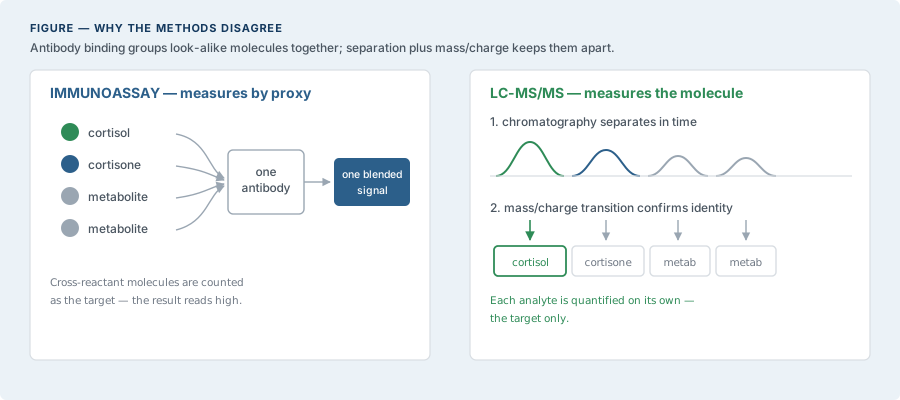
An immunoassay does not see a molecule; it sees whatever its antibody binds. When two molecules share enough structure, the antibody counts both, and the reported concentration is the sum of the target plus its look-alikes.
A mass spectrometer, by contrast, first separates compounds chromatographically in time, then confirms each by a mass-to-charge transition specific to that molecule.
The practical consequence is a difference in what the number means: an immunoassay result is a binding estimate, an LC-MS/MS result is a structural measurement.1,2,8
This is not a marginal distinction. A 2024 review of the technology’s clinical evolution frames specificity and sensitivity as the defining reasons LC-MS/MS has spread through reference laboratories, and an operations-focused review reaches the same conclusion on its analytical advantage over antibody-based platforms.1,2
2. Cross-reactivity is real, measurable, and clinically consequential
Cortisol is the clearest case. Antibody-based cortisol assays cross-react with cortisone and other structurally related metabolites, a problem especially pronounced in saliva and urine.
A dedicated method-comparison review concludes that LC-MS/MS yields more accurate results, considerably reduced variation across laboratories, and avoids false positives — while also enabling tasks immunoassays cannot perform, such as distinguishing exogenous corticosteroids or confirming dexamethasone exposure within a suppression test.3
A companion screening review makes the mechanism explicit: antibody measurement of cortisol generates false positives through cross-reactivity between cortisol, cortisone and other metabolites, whereas structurally based assays measure cortisol alone.4
3. The bias signature: immunoassays read high
When the two methods are run on the same samples, the divergence is directional.
In women evaluated for androgen excess, immunoassay-measured 17-hydroxyprogesterone ran far above LC-MS/MS — median values of roughly 5.5 and 3.6 nmol/L by two ELISA kits versus 1.6 nmol/L by LC-MS/MS — and testosterone, androstenedione and DHEA-S were likewise overestimated.7
The cost was concrete. Unnecessary follow-up diagnostic procedures were undertaken in 85% of patients with one immunoassay kit and 50% with another, and in none when LC-MS/MS was used.7
The capability behind that accuracy is chromatographic: LC-MS/MS can resolve isobaric steroids — 21-deoxycortisol, 11-deoxycortisol and corticosterone, for example — that antibodies cannot tell apart.8 Clinical guidance on hyperandrogenism has positioned mass spectrometry as the emerging standard over direct immunoassay.9
4. Estradiol and the low-concentration ceiling
The Endocrine Society’s position statement on estradiol is the authoritative reference. It concludes that although immunoassay and LC-MS/MS are both adequate for fertility-range work, imprecision and method-to-method differences remain problematic, and the very low estradiol concentrations relevant outside reproduction are frequently too low to be measured accurately or precisely by routine assays.5
Method-development work shows where LC-MS/MS extends that ceiling: a derivatisation-free assay reached a limit of quantification of 7.5 pmol/L and correlated closely with a chemiluminescent immunoassay while showing a systematic negative bias against it — that is, the immunoassay again read higher.6
Where Clinicore’s own estradiol measuring interval falls, and what it does and does not support, is stated in the estrone and estradiol review.
5. Beyond hormones: standardisation and 25-hydroxyvitamin D
The pattern is not confined to steroids.
Compared against certified reference material SRM 972, only LC-MS/MS results fell close to the certified values; three automated immunoassays diverged in different directions, and that divergence shifted the apparent prevalence of vitamin D insufficiency by more than ten percentage points depending on method.10
In a large population survey, LC-MS/MS 25-hydroxyvitamin D averaged 12.9 ng/mL higher than a radioimmunoassay on the same samples — a gap large enough to require statistical harmonisation before results could be compared.11
The implication for any test informing a threshold decision is the same: a patient’s classification can hinge on which assay a laboratory happens to run, and LC-MS/MS is the method that tracks the reference standard.
Table 1. Representative method-comparison findings
| Analyte | Matrix | Reported finding | Ref. |
|---|---|---|---|
| 17-OHP and androgens | Serum | Immunoassay ~2–3.5× higher; unnecessary workups 50–85% versus 0% | 7 |
| Cortisol | Saliva, urine, serum | Antibody cross-reactivity with cortisone and metabolites; MS reduces inter-laboratory variation | 3, 4 |
| Estradiol | Serum | Low concentrations below reliable routine accuracy; immunoassay positive bias | 5, 6 |
| 25-OH vitamin D | Serum | Only LC-MS/MS near SRM 972; RIA ~12.9 ng/mL difference | 10, 11 |
6. The known trade-offs, and where they land
A credible account does not pretend LC-MS/MS is free. The same reviews that praise its specificity flag genuine constraints: most LC-MS/MS assays are laboratory-developed rather than turnkey kits, carrying heavier validation, quality-assurance and troubleshooting responsibilities,2 and broader adoption is still limited by lower automation, the need for method-specific reference intervals across diverse populations, and immature commercial quality-control materials.1
Critically, these are laboratory-side costs. They are borne by the laboratory that develops, validates and monitors the assay — not by the clinician who orders it.
Clinicore’s role is to carry that operational weight so what reaches the ordering provider is the analytical benefit on its own: a result that reflects the molecule, not the antibody’s best guess. How a method becomes reportable here is set out on the validation page.
7. What this means for the ordering clinician
When a result will inform interpretation near a decision threshold — an androgen in a woman with suspected excess, a low estradiol, a cortisol read against a suppression test, a borderline vitamin D — the assay’s specificity is not a technical footnote. It is the difference between a number you can act on and one that may send a patient down an unnecessary path.3,5,7
The thesis of this series follows directly. Measuring a pathway and reading the ratio between two analytes only means something if each analyte is measured accurately. Antibody cross-reactivity corrupts exactly that — a cortisol-to-cortisone ratio is meaningless if the cortisol antibody is also counting cortisone.
Structural measurement is the precondition for every ratio in this series.
References
- Yu S, Zou Y, Ma X, et al. Evolution of LC-MS/MS in clinical laboratories. Clin Chim Acta. 2024;555:117797.doi:10.1016/j.cca.2024.117797
- Rappold BA. Review of the use of liquid chromatography-tandem mass spectrometry in clinical laboratories: Part II — Operations. Ann Lab Med. 2022;42(5):531–57.doi:10.3343/alm.2022.42.5.531
- Casals G, Hanzu FA. Cortisol measurements in Cushing's syndrome: immunoassay or mass spectrometry? Ann Lab Med. 2020;40(4):285–96.doi:10.3343/alm.2020.40.4.285
- Ceccato F, Boscaro M. Cushing's syndrome: screening and diagnosis. High Blood Press Cardiovasc Prev. 2016;23(3):209–15.doi:10.1007/s40292-016-0153-4
- Rosner W, Hankinson SE, Sluss PM, Vesper HW, Wierman ME. Challenges to the measurement of estradiol: an Endocrine Society position statement. J Clin Endocrinol Metab. 2013;98(4):1376–87.doi:10.1210/jc.2012-3780
- Won EJ, Yi A, Ko YJ. Analytical performance evaluation for estradiol using liquid chromatography-tandem mass spectrometry. Clin Biochem. 2023;113:59–63.doi:10.1016/j.clinbiochem.2023.01.003
- Ambroziak U, Kępczyńska-Nyk A, Kuryłowicz A, et al. LC-MS/MS improves screening towards 21-hydroxylase deficiency. Gynecol Endocrinol. 2015;31(4):296–300.doi:10.3109/09513590.2014.994599
- Keevil BG. Novel liquid chromatography tandem mass spectrometry (LC-MS/MS) methods for measuring steroids. Best Pract Res Clin Endocrinol Metab. 2013;27(5):663–74.doi:10.1016/j.beem.2013.05.015
- Pugeat M, Déchaud H, Raverot V, et al. Recommendations for investigation of hyperandrogenism. Ann Endocrinol (Paris). 2010;71(1):2–7.doi:10.1016/j.ando.2009.12.007
- Moon HW, Cho JH, Hur M, et al. Comparison of four current 25-hydroxyvitamin D assays. Clin Biochem. 2012;45(4–5):326–30.doi:10.1016/j.clinbiochem.2011.12.025
- Berry DJ, Dutton J, Fraser WD, Järvelin MR, Hyppönen E. Harmonization study between LC-MS/MS and Diasorin RIA for measurement of 25-hydroxyvitamin D concentrations in a large population survey. J Clin Lab Anal. 2016;31(3):e22049.doi:10.1002/jcla.22049
Tests discussed in this review
Related reviews
Download this review as a PDF — for printing or sending on. The page above is the current version.