Small-volume collection
A standard venous draw fills a tube with four to ten millilitres of blood and requires a phlebotomist. Clinicore’s endocrine hormone panel runs on 0.15 mL of serum.
That gap is the whole subject of this page. Once the volume a method needs drops far enough, the collection stops needing a phlebotomist — and once that happens, timed collection and at-home collection become practical rather than logistically difficult.
What makes it possible
Two things, together:
Tandem mass spectrometry. LC-MS/MS separates compounds chromatographically and confirms each by a mass-to-charge transition specific to that molecule. It is sensitive enough to measure a full steroid panel from a fraction of the sample an immunoassay-based menu would need, and it multiplexes — one small specimen, many analytes.
Robotic sample preparation. Handling microlitre volumes reproducibly is not something a pipette and a steady hand do well. Automated preparation is what makes a 30 µL sample behave like a routine specimen rather than a special case.
Three collection routes
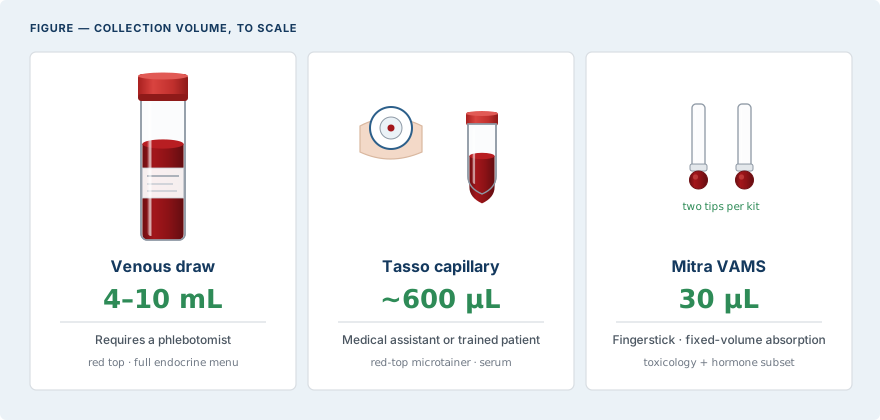
Venous — standard venipuncture, serum or whole blood. Requires a licensed phlebotomist. The primary validated matrix and the full endocrine menu.
Tasso — capillary serum, about 600 µL. Collected by a medical assistant or a properly trained patient. Carries the full endocrine menu.
Mitra — a volumetric absorptive microsample, 30 µL per tip. The kit holds two tips, so a second run or a hormone panel is available from the same collection event without going back to the patient.
Device, volume, stability and transport for each are on the collection pages.
A Mitra is not a dried blood spot
This is the distinction that matters most, and it is the one most often collapsed.
A traditional dried blood spot is a drop of blood spread onto card. The analysis punches a fixed-diameter disc from that spot — but how far a drop spreads depends on its haematocrit, so the punch contains a blood volume that varies from patient to patient. That variability sits underneath every concentration calculated from it.
Volumetric absorptive microsampling absorbs a fixed volume — 30 µL, independent of haematocrit. The quantity of blood is known before anything is measured, which is what supports an accurate quantitative concentration from a microsample rather than an approximate one.
If a specimen is described as a dried blood spot, it is not this.
Does the smaller collection give the same answer
Clinicore ran a controlled comparison rather than assuming it. Capillary specimens were collected alongside venous draws from the same volunteers at the same moment, and each analyte was evaluated by Passing-Bablok regression — chosen because it assumes measurement error in both methods rather than treating one as a reference standard.
Agreement was established across the analytes evaluated, with one exception that is stated rather than buried: dihydrotestosterone was not among them. Its slope sat well outside the range the other analytes produced, and the finding does not extend to it.
The study, its design and its per-analyte results are published separately.
Stability
Stability figures for the Mitra are the durations the studies were carried to, not the points at which analytes fail. The hormone study was stopped at 10 days. The toxicology study was deliberately extended to 28 days so that a physician requesting a retest on the original specimen can have one — which is a service statement rather than a specification, and few laboratories offer it.
One constraint runs the other way. Pregnenolone is stable for 72 hours in a red-top tube, against 5 days for everything else on the endocrine panel. On a Mitra it extends to 10 days, which is a concrete reason to prefer the microsample where pregnenolone is ordered.
What is offered today
Tasso currently carries the endocrine menu. Mitra carries the full toxicology menu plus six hormones — cortisol, cortisone, progesterone, testosterone, androstenedione and pregnenolone.
This page describes what is offered now, not what has been validated for future use.